Ramen Noodles
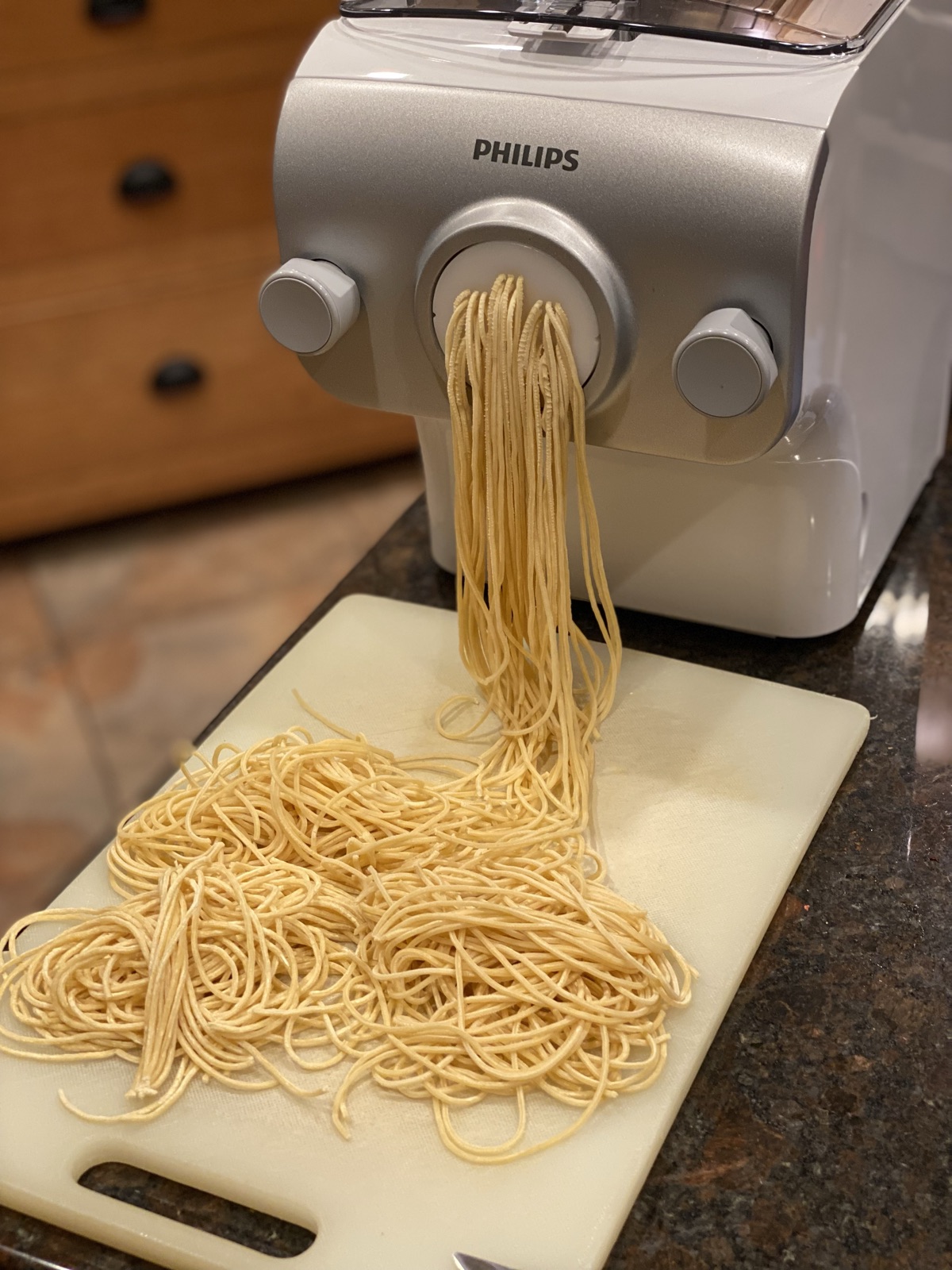
Basic Ramen for Philips Pasta Machine
Flour 200 g bread flour / 2 g salt
Fluid 65 g water
Quantity of pasta / noodle ~200 g
Tokyo Style for Philips
Per portion: measure everything by weight (up to 4x for machine)
99g King Arthur bread flour (12.7% protein by weight)
1 g vital wheat gluten (aprox 77.5% protein by weight)
1 g egg white powder
38 g water
1 g salt
1.2 g baked soda
Sapporo Style
Sapporo noodles are fairly minerally, chewy, and curly. So I up the water content, gluten content, and alkaline content to promote more chew and flavor than a standard Tokyo noodle. Some Sapporo ramen noodles also have egg white (around 1 egg white per 500 grams flour), but I haven’t played with this much. If you were interested, simply replace some of the water with equal weight egg white.
Per portion: measure everything by weight
98.5g King Arthur bread flour (12.7% protein by weight)
1.5 g vital wheat gluten (aprox 77.5% protein by weight)
42 g water
1 g salt
1.5 g baked soda (more info on baked soda below)
Optional: a pinch of Riboflavin (this adds color)
Steps:
Add baked soda and salt (and riboflavin if using) to the water, dissolve completely. I like to add one at a time, it seems like the baked soda dissolves better if added prior to the salt.
In the food processor, add your wheat gluten and flour. Pulse a few times to combine the two.
While running the food processor, add your water mixture slowly, in an even stream. Occasionally, stop to scrape the sides down. You know you’re set when you have tiny grain like pieces.
Cover the food processor and let this rest for 30 minutes. This gives the flour granules time to fully absorb the water and alkaline salts.
Knead it. Currently I use an electric pasta machine to sheet the dough, going through the largest setting, then the 2nd, then the 3rd, then folding and repassing through the largest setting. I repass two to three times, or until I notice the dough is making the machine work really hard. I also like to fold the dough the same direction each time. Some articles I read suggested this kept the gluten strands running in the same direction, which promotes better texture. You’ll notice interesting horizontal lines running along the length of your dough if you do it right. If this isn’t an option for you, I used to throw the mix into a plastic bag and step on it repeatedly, which simulates the kneading process used in an industrial setting.
When smooth, cover with plastic, and rest at room temp for an hour. This gives the gluten time to relax, and “ripens” the dough according to Japanese cooks.
Pull out your dough. Portion into workable sizes (around one serving’s worth), and roll out to desired thickness, using potato starch as you go to prevent sticking. Do this with a pasta machine, it is borderline impossible without a machine. An electric one will save you an incredible amount of effort.
Cut your noodles to your desired thickness.
Take a handful of finished noodles and squeeze the noodles together into a tight ball, like a snowball, then shimmy them around to create the classic wavy effect. Repeat until crinkled to your liking.
Ideally you should make these noodles in advance. Sapporo noodles are best after around 2 days in the fridge. They firm up a bit and develop more flavor. The general rule for this cure is that the higher the hydration, the longer the wait. You can, of course, also bag them up and freeze them; they freeze extremely well.
Baked Soda
Baking soda is sodium bicarbonate, which already includes one proton and so has a limited ability to take up more. But if you heat baking soda, its molecules react with one another to give off water and carbon dioxide and form solid sodium carbonate, which is proton-free.
Just spread a layer of soda on a foil-covered baking sheet and bake it at 250 to 300 degrees for an hour. You’ll lose about a third of the soda’s weight in water and carbon dioxide, but you gain a stronger alkali. Keep baked soda in a tightly sealed jar to prevent it from absorbing moisture from the air. And avoid touching or spilling it. It’s not lye, but it’s strong enough to irritate.